
Palo Alto · Midtown What has sold in Midtown.
Every single-family sale recorded in Midtown over the period stated below — where each one is, what it fetched, and how it did against the price it first asked.
Midtown · Palo Alto
What this neighborhood actually did.
Closed sales of single-family homes in Midtown, Palo Alto, from October 15, 2025 to October 15, 2026. Source: MLSListings. Each sale is listed with the firm that represented the seller. Information deemed reliable but not guaranteed. Figures are medians rather than averages — one very large sale should not move a neighborhood’s number. 1206 sales were recorded in this period; 43 of them carried coordinates and are drawn here. Base map data © OpenStreetMap contributors.
What this place is
Seven Eichler tracts, a Mexican land-grant hacienda site, and the expressway vote that split the city and created its politics.
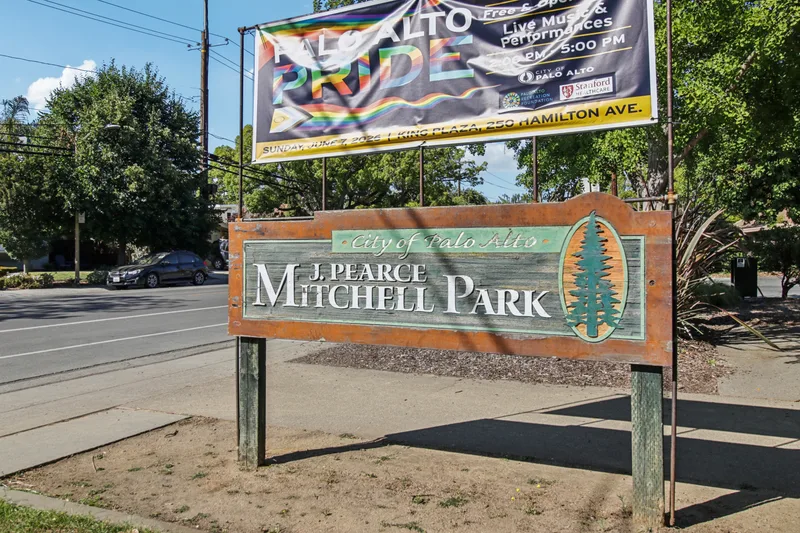
Midtown is where Palo Alto’s post-war house-building happened at scale.
Seven separate Eichler tracts sit inside it, built between 1950 and 1972 — Greer Park, three phases of Channing Park, Midfair, Triple El, Louis Road and Midcourt — with Anshen & Allen and Jones & Emmons among the architects.
The land underneath was Rancho Rincón de San Francisquito, bought by Secundino Robles and his brother in 1847.
Their hacienda stood at the end of San Antonio Road until the 1906 earthquake destroyed it; a marker at Alma and Ferne records where.
And Midtown’s northern edge is Oregon Expressway, which is not a natural boundary but a decision. Voters approved it in June 1962 by 402 votes out of more than eighteen thousand cast.
Over ninety houses came down to build it.
The campaign against it launched the residentialist movement that has shaped every large Palo Alto planning fight since — the whole idea of "north" and "south" Palo Alto dates from that vote.
The specifics
- Seven Eichler tracts: Greer Park (1950–51, 131 lots, Anshen & Allen), Channing Park 1 and 2 (1951–52, 57 lots), Channing Park 3 (1955, 20 lots), Midfair (1953–54, 22 lots), Triple El (1955, 68 lots, Jones & Emmons), Louis Road (1959, 5 lots) and Midcourt (1972, 9 lots, Claude Oakland).City of Palo Alto — Eichler Neighborhood Design Guidelines
- Secundino Robles and his brother bought the 8,418-acre Rancho Rincón de San Francisquito in 1847. Their hacienda at the end of San Antonio Road was destroyed in the 1906 earthquake; Robles Park was renamed for him in 1968.Palo Alto Museum
- Oregon Expressway was approved on June 5, 1962 by 402 votes — 9,432 to 9,030 — and built in 1962–63. Over ninety houses were demolished for it.Palo Alto Historical Association
- The Lawrence Tract, broken ground February 1950, was a deliberately integrated subdivision of 25 three-bedroom redwood houses on Lawrence Lane, Greer Road and Colorado Avenue, built when such a thing was rare. It was organised by the Palo Alto Fair Play Council with Paul Lawrence, a Howard University professor, who secured the land and financing. Houses sold for about $9,000.The Almanac
- Across the city, Palo Alto has roughly 2,700 Eichler homes in more than thirty tracts built between 1949 and 1974 — typically three bedrooms and about 1,200 square feet, originally $10,000 to $14,000.City of Palo Alto — Eichler Neighborhood Design Guidelines
Midtown in one paragraph
43 homes sold in Midtown over the last year, at a median of $3.82M — below the Palo Alto median of $4.05M.
The typical one is a 1,780 sq ft single-story house from 1952 on a 6,660 sq ft lot, at $2,284 a square foot.
Against the price sellers first asked — not the price they had been reduced to — the median sale here finished +10.1%, and 81% of sellers got at least their asking price.
That is stronger than Palo Alto as a whole, where the median is +5.6%: Midtown gets bid up harder than the city average.
Not planning to sell? That’s fine.
Curious how your home fits today’s market?
Sometimes homeowners simply want a current perspective on the house they’ve lived in for years — how it fits today’s market, what I would or wouldn’t change, or what recent nearby sales may mean for it.
I’m happy to stop by and give you my perspective. No need to prepare the house, and no selling timeline required.
Ask Maggie to take a look →
Thank you. I’ll reach out personally to talk about what would be helpful.
— Maggie
In Midtown, the first two weeks are the sale
Every sale grouped by how long it took, against the price it first asked. Not against a reduced price — against the number it launched at.
Too few sales in Midtown’s outer bands to read this one on its own, so here is the wider market it sits in: homes that sell in the first week finish +10.3% against their opening price and 97% reach it; past sixty days the median is −11.7% and 7% reach it. Whatever is going to happen, happens early.
Every sale: what it fetched, and how it did
One dot per home. Across is the result against the price it first asked. Up is what it actually sold for. Red beat its asking price; charcoal did not.
The dashed lines are the two medians — $3.82M and +10.1%. A dot to the right of the upright line beat the price it opened at; a dot above the flat one sold for more than the typical home here.
What the corners tell you is whether the top of Midtown behaves like the rest of it.
From my tours
Houses I’ve walked through in Midtown
I tour new listings here every week. These are my notes — what I noticed inside, and when a house sells, what happened.
If this is your street
The map says what sold. It doesn’t say what yours would.
Two houses on the same Midtown block can be hundreds of dollars a square foot apart, and the difference is almost never the house — it is what was done to it before anyone saw it.
Maggie will tell you which of those things is worth doing on yours, and which is not.