
Palo Alto · College What has sold in College.
Every single-family sale recorded in College over the last twelve months — where each one is, what it fetched, and how it did against the price it first asked.
College · Palo Alto
What this neighborhood actually did.
Closed sales of single-family homes in College, Palo Alto, from September 2, 2025 to September 25, 2026. Source: MLSListings. Each sale is listed with the firm that represented the seller. Information deemed reliable but not guaranteed. Figures are medians rather than averages — one very large sale should not move a neighborhood’s number. 446 sales were recorded in this period; 28 of them carried coordinates and are drawn here. Base map data © OpenStreetMap contributors.
What this place is
The one Palo Alto neighborhood that beat Leland Stanford to the name "Palo Alto" — and lost it in a settlement for $1,000.
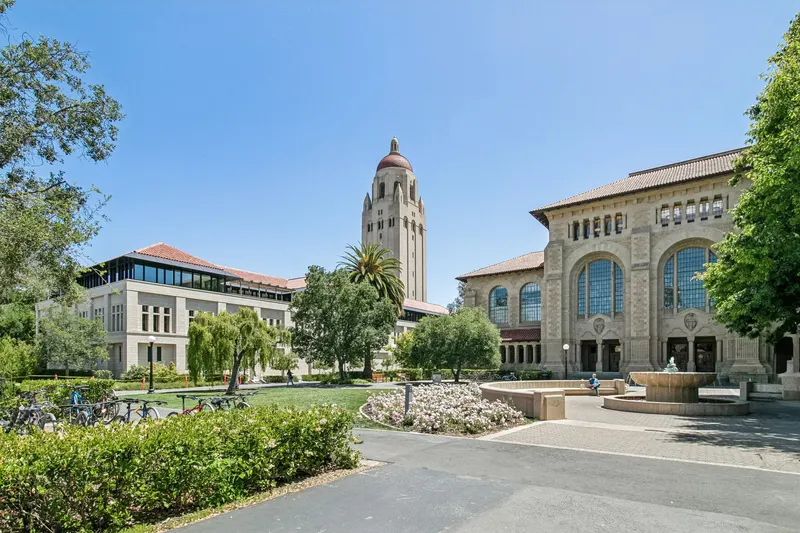
Alexander Gordon, a San Mateo farmer, bought 120 acres in 1887, laid out the streets himself, called the place Palo Alto and recorded his map in 1888. Stanford recorded "University Park" the following year, sued over the name, lost, and paid Gordon $1,000 to hand it over. Gordon renamed his tract College Terrace.
He named the streets alphabetically after East Coast colleges, running from Amherst at the high western end down to Yale at El Camino. The alphabet breaks at Cornell, and there is a reason: when Palo Alto absorbed the town of Mayfield in 1925, duplicate street names had to be resolved, and Washington Street became Cornell. It is a retrofit, not Gordon’s.
The architecture stacks in layers — 1890s Queen Anne, 1900s Colonial and Mission Revival cottages, and a run of 1930s Spanish Colonial cottages by Pedro de Lemos with carved wood grilles and tiled chimneys.
The specifics
- Alexander Gordon bought 120 acres in 1887, subdivided them himself and recorded the name “Palo Alto” in 1888 — a year before Stanford’s University Park map. Stanford sued, lost, and paid $1,000 in settlement for the name.The Almanac
- Streets run alphabetically by college from the western edge to El Camino: Amherst, Bowdoin, Columbia, Cornell, Dartmouth, Harvard, Oberlin, Princeton, Wellesley, Williams, Yale.
- Cornell breaks the sequence because it was a rename. When Mayfield consolidated with Palo Alto in 1925, Washington Street became Cornell, Palo Alto Avenue became College Avenue, and Mayfield’s Lincoln Avenue became California Avenue.College Terrace Residents’ Association
- The Kee House at 2310 Yale (1889) is the oldest surviving building from the town of Mayfield, and was listed on the National Register on April 11, 1985.
- The neighborhood was annexed by the town of Mayfield in 1891, and came into Palo Alto when Mayfield consolidated on July 6, 1925 by a vote of 1,094 to 441.
- Palo Alto’s Historic Resources Board has singled out College Terrace’s own building types as needing further study — square cottages, two-story square boxes, and cottage courts.
College in one paragraph
28 homes sold in College over the last year, at a median of $3.79M — below the Palo Alto median of $4.01M. The typical one is a 1,687 sq ft two-story house from 1928 on a 6,250 sq ft lot, at $2,116 a square foot.
Against the price sellers first asked — not the price they had been reduced to — the median sale here finished +3.2%, and 75% of sellers got at least their asking price. That is weaker than Palo Alto as a whole, where the median is +5.5%. Here the first number has to be closer to right, because the market is less inclined to correct it upward.
In College, the first two weeks are the sale
Every sale grouped by how long it took, against the price it first asked. Not against a reduced price — against the number it launched at.
Too few sales in College’s outer bands to read this one on its own, so here is the wider market it sits in: homes that sell in the first week finish +10.4% against their opening price and 98% reach it; past sixty days the median is −11.7% and 3% reach it. Whatever is going to happen, happens early.
Every sale: what it fetched, and how it did
One dot per home. Across is the result against the price it first asked. Up is what it actually sold for. Red beat its asking price; charcoal did not.
The dashed lines are the two medians — $3.93M and +3.6%. A dot to the right of the upright line beat the price it opened at; a dot above the flat one sold for more than the typical home here. What the corners tell you is whether the top of College behaves like the rest of it.
If this is your street
The map says what sold. It doesn’t say what yours would.
Two houses on the same College block can be hundreds of dollars a square foot apart, and the difference is almost never the house — it is what was done to it before anyone saw it. Maggie will tell you which of those things is worth doing on yours, and which is not.